



Hilliard Davidson High School (my high school) requires all students to complete a senior capstone. The capstone wasn't supposed to be anything super intense, but it was an unnecessary addition to a very busy senior schedule. I was way to busy trying to balance sports (Cross Country/track), classes (Calc II, Physics Mechanics/E&M), and a social life to be worried about a capstone. Well you were encouraged to complete the capstone outside of school, there were also a couple of options to complete the capstone within the school day. I figured this would would be the best option for me as it would give me dedicated time to work on the capstone. This could be done as a
One of the options to complete the capstone was Engineering Design and Development (EDD). As the fourth class in the high school engineering sequence, it gave students a chance to utilize the various skills they learned in the first three classes to create a prototype for something they cared about. Every friday our teacher would invite an actual engineer to our class to talk about what they do at work. It was a really cool experience and definetly cemented the idea that I wanted to study engineering in college.
The start of the year was entirely dedicated to brainstorming ideas. I was in the middle of my cross country season. This led to a lot of my ideas being dominated by running and technology. My inspiration looked something like this
-
- Laces that don't become untied
- Better way to remove spikes from shoes
- A thicker spike bag
Running Shoes/Spikes:
-
- Putting a clock in a baton
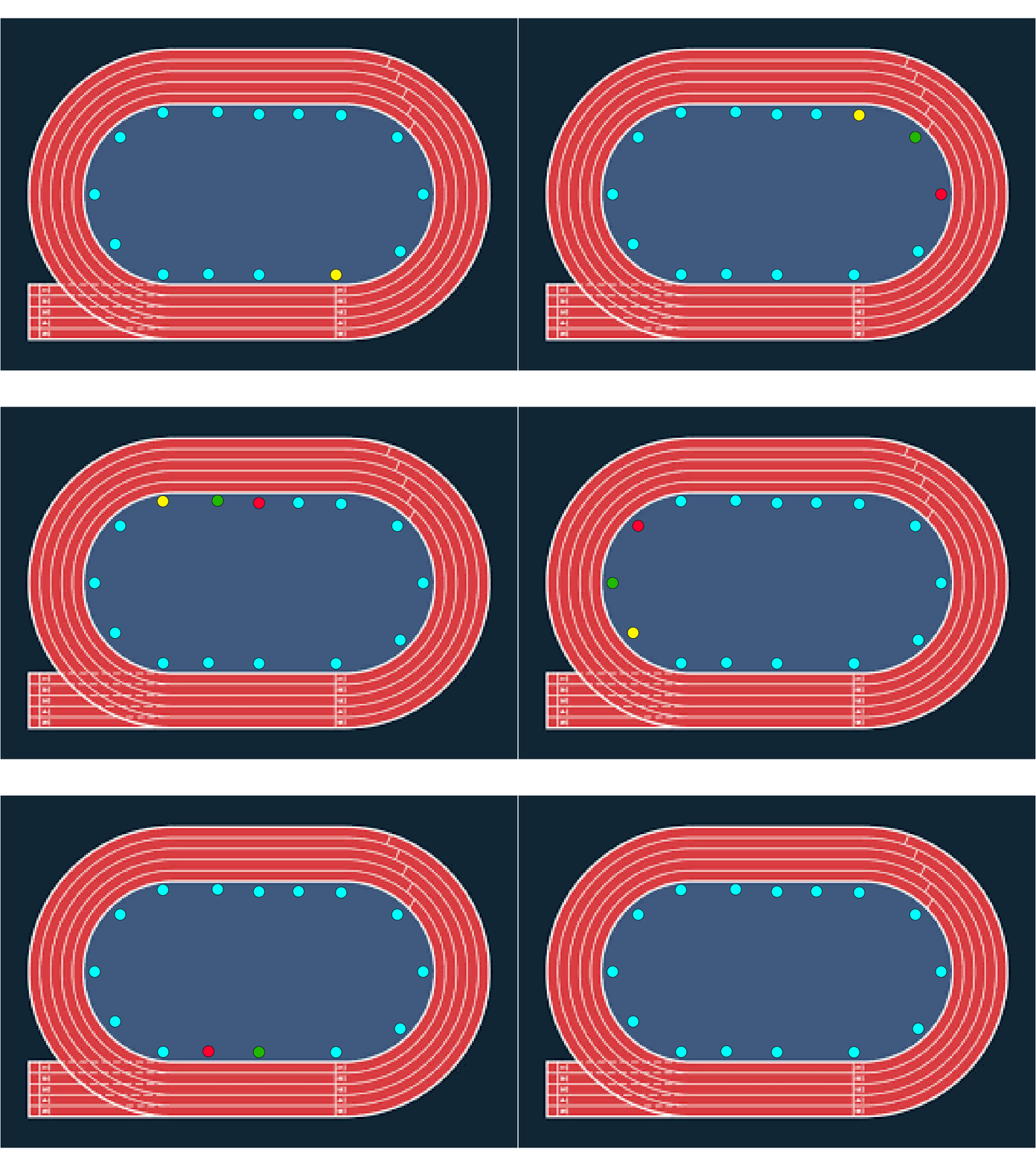
- Wavelight pacing guide
- Watch chargers built into the track
Pacing
-
- Improved method of attaching race bibs (I hate the safety pins)
- Shirt that doesn't chafe
- Running shorts that dry faster
Apperal
EED Project Inspiration
We went through a whole process where everyone presented their ideas, and the one that stook out the most was the wavelight pacing system.
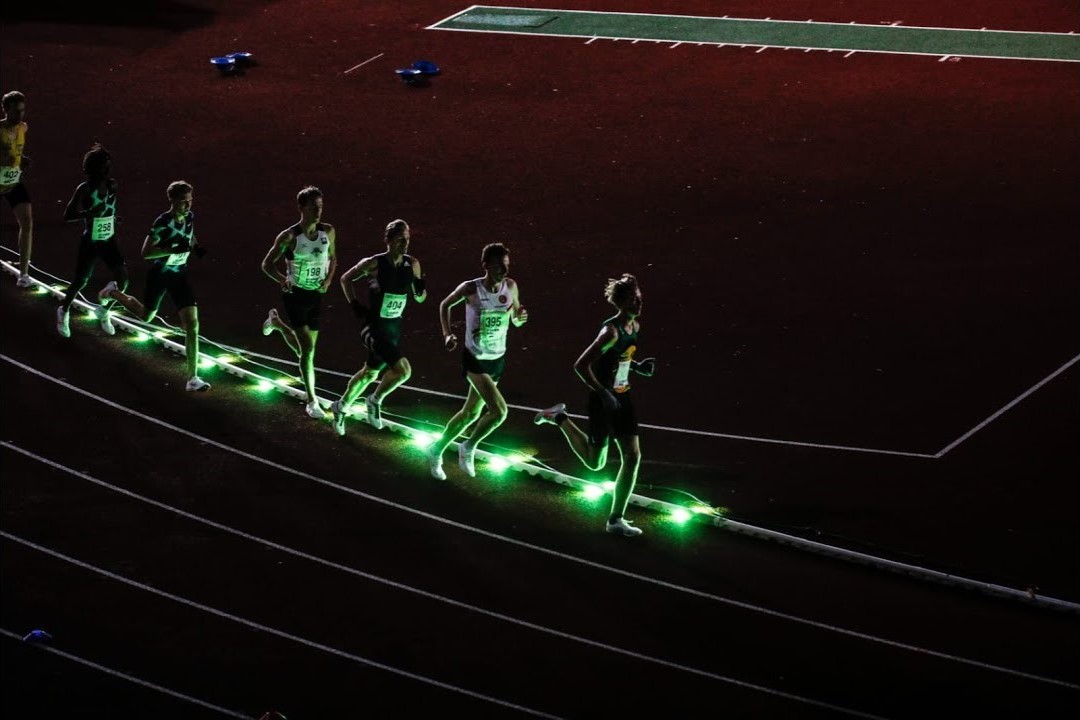
The wavelight system is a professional pacing system designed to assist runners run even paces. Running even paces is one of the hardest things to do as a runner, so having a visual clue can be very helpful. At the high school level, runners struggle a ton with running even splits.
The next question became how could it be adapted to a high school level. It took a little while, but we figured it would be best to break it into modular components. This gave the following advantages...
- Weather
- Most Wavelights have been installed in southern locations.
- Ohio gets lots of snow and ice that would be bad for the electronics.
- Having the ability to move the system into a shed would help the system last.
- Sharing the track
- At the High School level, the track surrounds the football/soccer field
- Throughout the week there are might be 5 different games
- It would be nice to move the system so that it isn't messed with by unfamiliar students
- Not every run is on the track
- During Cross Country season, all of the races are on grass
- It's better for injury prevention to not run every single race on the track
- Modular lights can be used on both the grass and the track
Advantages of a modular wavelight pacing system
This led the group to a cone design. Cones are used in various sports to train all sorts of things. They have the advantage of being super easy to setup and take down. They can also be setup in various patterns, on any terrain. Basing a track pacing lights on cones just makes sense.
Our first prototype utilized a colored spotlight that my friend found on clearance. At the time, we had no clue how we were going to make the electronics work. So a pre-made cone that we could tear down was best. After smashing the Garden Ridge spotlight housing, we transplaneted the circuit board and it's lights into a cone housing. It wasn't great, but it gave us a prototype to show our classmates, and it let us estimate the distance we would be able to see the lights from.
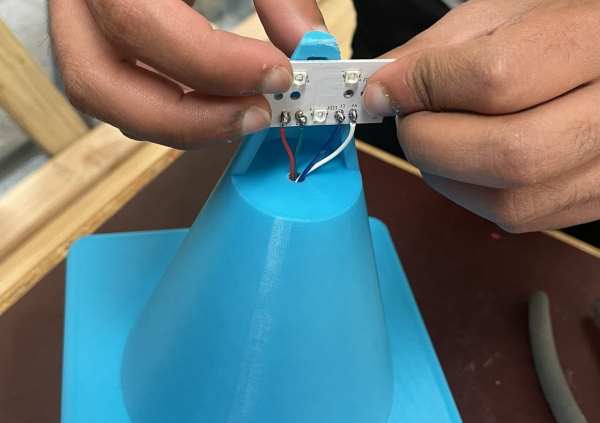
From there we decided to pivot to an actual prototype. We wanted this prototype to be accesible in scope but scalable up to at least 8 cones. In order to connect the cones we knew we needed to use a wireless solution. Our initial idea was to use wifi or bluetooth, but we ran into range problems with those. So we pivoted to using LoRa 915MHz radios. These were listed as having a range of 2000 meters. That was definitely enough to work from anywhere on our school grounds.
In order to control the radio, we needed a microcontroller. We chose the Arduino Nano Every because it was cheap. To make the light, light up, we bought a 3W RGB LED Breakout module because it looked like it would be pretty bright. Finally, we needed a way to power everything. For this we bought two Anker portable phone chargers. They were probably overkilll for our project, but they were easy to use, and easy to charge. We also bought them knowing we would be able to use them as normal phone chargers once this project was over.
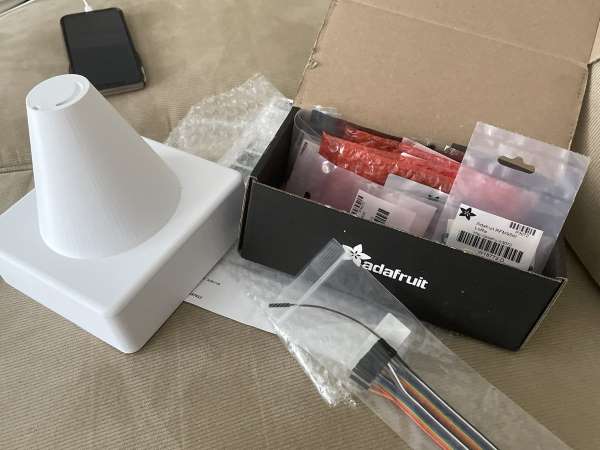
Because we were using breakout boards, everything went together pretty simply. We made most of our connections with jumper wires, and proceded to hot glue everything into the underside of the cone. It was most definetly a little janky, but it worked for what we wanted to do.
As the year wrapped up, we were able to get everything put together and programmed. We had the opportunity to present our idea to our friends and classmates at the end of the year showcase.
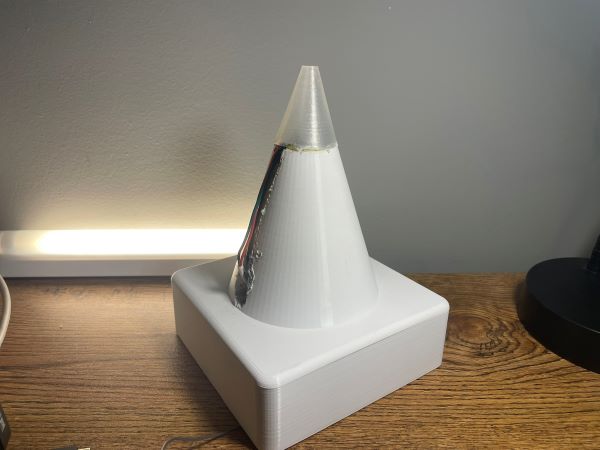
Unfortunately, the year ended before we had the opportunity to test our project out on the track. Since the end of high school, I'vve learned a ton of things that I think could be used to improve this product. Someday I would like to revisit this projet and get an 8 cone version working. I just need to find the time and a way to decrease the cost per cone.